

Table of Contents
- Why AI Art Styles Are Reshaping Wall Decor in 2026
- 1. Photorealistic AI Art: When Digital Looks Like a Photograph
- 2. Minimalist and Line Art Styles for Clean, Modern Spaces
- 3. Surrealism and Abstract Art: Bold Statements for Gallery Walls
- 4. Anime and Ghibli-Inspired Styles for Nostalgic Charm
- 5. Cyberpunk and Retro-Futurism: Neon Energy for Creative Spaces
- 6. Art Deco and Art Nouveau Revival: Timeless Elegance Reimagined
- 7. Botanical and Nature-Inspired Art for Calm, Organic Interiors
- How to Upscale AI Art for Wall Decor
- Tips for Better AI Art Prompts
- Matching AI Art Styles to Your Room
- Printing and Material Choices That Hold Detail
- Frequently Asked Questions
Last Updated: September 15, 2026
Why AI Art Styles Are Reshaping Wall Decor in 2026
AI art styles have moved from novelty to a practical design tool for anyone furnishing a room. At Vireous.Shop, we've watched generative art shift from a screensaver curiosity into a genuine wall decor category, because a text-to-image model can now produce a finished visual composition in minutes rather than weeks. The hard part was never generation. It's matching a style to a room, then getting that file onto a physical surface without losing detail.
That second step is where most guides stop, and where most rooms go wrong.
Below, we break down the ten best AI art styles for wall decor, what each one does to a space, and the prompt and print details that decide whether the result looks like a gallery piece or a poster.
1. Photorealistic AI Art: When Digital Looks Like a Photograph
Photorealism is the style that convinces guests the piece is a photograph until they lean in. Modern image generation models handle skin texture, fabric weave, and depth of field well enough that a high-resolution render holds up at large sizes.
Where it works best: a single large canvas in a quiet room, or a paired diptych over a bed. Photorealistic pieces reward empty wall space because there's no pattern to compete with.
The catch is resolution. A photorealistic render that looks sharp on a phone screen can soften noticeably when printed at a large canvas size, so upscaling matters more here than in any other style on this list (nps.gov). We'll cover that technique further down.
2. Minimalist and Line Art Styles for Clean, Modern Spaces
Minimalism is the safest entry point into AI wall decor, and the easiest to get wrong. A single continuous line drawing, a restrained color palette, and generous negative space can look intentional and expensive. The same three elements done sloppily look like a placeholder.
Line art suits hallways, home offices, and any wall that already has visual weight from furniture. Keep the frame thin and the mat wide.
A common mistake is generating minimalism with too much detail in the prompt. Words like "intricate" or "highly detailed" fight the style. Ask for "single continuous line, two colors, vast negative space" instead.
3. Surrealism and Abstract Art: Bold Statements for Gallery Walls
Surrealism and abstract work is where AI art styles earn their reputation as conversation pieces. A floating staircase, a door opening onto water, a figure rendered in impossible proportion: these images give a gallery wall its anchor.
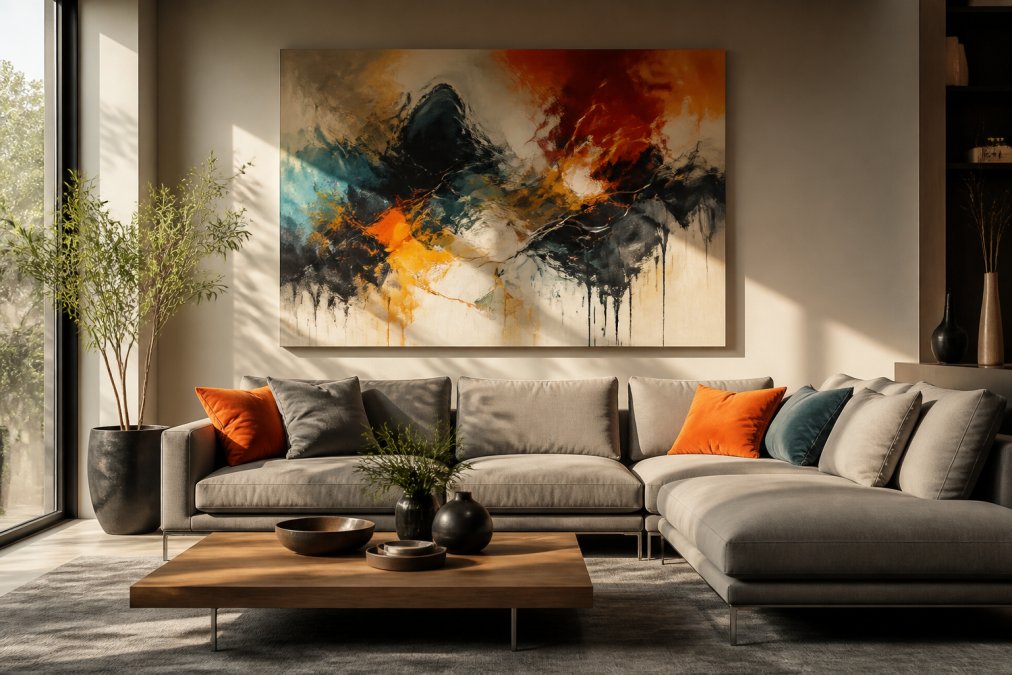
For a curated gallery wall, pair one large surrealist canvas with two smaller abstract pieces in a shared color family. The large piece carries the theme; the smaller ones echo it.
Vireous.Shop's Psychedelic Japan series leans directly into this territory, and the abstract, geometric energy in those canvases is exactly the kind of piece that holds a wall on its own. You can see the range in the Psychedelic Japan Abstract Art Canvas Art Print, which runs across 24 sizes in horizontal, vertical, and square formats.

4. Anime and Ghibli-Inspired Styles for Nostalgic Charm
Anime-inspired art carries a specific emotional register: warm light, soft skies, quiet domestic scenes. It reads as nostalgic rather than childish when the color grading stays muted and the composition stays simple.
This style works well in bedrooms, reading nooks, and creative studios. It pairs naturally with wood tones and warm lighting.
Keep in mind that "inspired by" is doing real work in that phrase. Copying a living artist's signature style or a studio's protected characters raises legal questions you don't want on a product you're selling or gifting (Copyright in General (FAQ)).
5. Cyberpunk and Retro-Futurism: Neon Energy for Creative Spaces
Cyberpunk delivers the strongest contrast of any style here: neon against deep shadow, rain-slicked streets, glowing signage. Retro-futurism pulls the same energy backward, borrowing the optimism of mid-century predictions about the year 2000.
Both styles belong in creative spaces, gaming rooms, and home offices where a screen already glows. They clash badly with neutral, traditional interiors.
The technical note for cyberpunk: neon gradients are where printers struggle most. Banding in a smooth magenta-to-cyan transition is the most common complaint on this style, so always request a proof before a large run.
6. Art Deco and Art Nouveau Revival: Timeless Elegance Reimagined
Art Deco and Art Nouveau are having a genuine revival, and AI generation handles both well because their rules are geometric and learnable. Deco gives you symmetry, stepped forms, and metallic accents. Nouveau gives you flowing organic linework and botanical curves.
Deco suits dining rooms, entryways, and formal living spaces. Nouveau suits bedrooms and powder rooms.
These two styles are the easiest to integrate into an existing traditional interior because their palettes tend toward gold, deep green, and cream, which most furniture already accommodates.
7. Botanical and Nature-Inspired Art for Calm, Organic Interiors
Botanical art is the most forgiving style on this list. Leaves, branches, and pressed-flower compositions work in almost any room, at almost any size, in almost any frame.
If you're building a gallery wall from scratch, start with botanical pieces and add bolder styles later. They're the neutral ground that lets surrealism and cyberpunk sit in the same room without a fight.
For a cohesive set, generate three botanical pieces with the same prompt structure and vary only the plant species. The shared composition style ties them together.
How to Upscale AI Art for Wall Decor
Upscaling AI art for wall decor means increasing the pixel dimensions of a generated image without introducing blur, banding, or false detail, so the file holds up when printed at large canvas sizes. Most image generation models output at a resolution that looks fine on screen but softens on a 24-inch print.
The practical workflow:
- Generate at the model's native resolution, then export the highest-quality version available
- Run the file through a dedicated upscaler rather than a standard photo editor's resize tool
- Target a print resolution of at least 150 pixels per inch at your final canvas size
Tips for Better AI Art Prompts
A useful template:
Three habits that separate good prompts from frustrating ones:
Matching AI Art Styles to Your Room
| Room | Best-Fit Style | Why It Works |
|---|---|---|
| Living room | Surrealism / abstract | Anchors a large wall, sparks conversation |
| Bedroom | Botanical / anime-inspired | Calm palette, low visual noise |
| Home office | Cyberpunk / retro-futurism | High energy, matches screen light |
| Dining room | Art Deco | Symmetry suits formal layouts |
| Entryway | Minimalist line art | Reads instantly at a glance |
| Gallery wall | Mixed, one anchor piece | Large piece sets the theme |
Printing and Material Choices That Hold Detail
Frequently Asked Questions
What are the best AI art styles for modern home decor?
For modern interiors, minimalist line art, abstract compositions, and photorealistic pieces work best. Minimalist styles suit clean, uncluttered spaces, while abstract art adds visual interest without overwhelming a room. Photorealistic AI art creates a focal point that feels like traditional photography. Consider your existing color palette and furniture style when choosing. A bold cyberpunk piece might clash in a serene bedroom but energize a home office. Test different AI art styles by generating small previews before committing to a large canvas print.
How do I write better prompts to get the AI art style I want?
Start with a clear subject and then add style keywords. For example, instead of 'a tree,' try 'a lone oak tree in watercolor wash style, soft pastel colors, minimalist composition.' Include specific art movements like art deco or surrealism, mention color palettes, and specify the mood. Adding terms like 'high-resolution' and 'fine art print quality' helps the AI generate detailed images suitable for wall decor. Experiment with different combinations and save prompts that produce results you love for future projects.
Can I upscale AI art for large canvas prints without losing quality?
Yes, but you need the right tools. AI art often generates at lower resolutions, so upscaling is essential for large prints. Use dedicated AI upscaling software that adds detail rather than just stretching pixels. Look for tools that offer 4x or 8x upscaling with noise reduction. For best results, start with the highest resolution your AI generator offers, then upscale in steps. Check the final image at 100% zoom before printing. Most print services recommend at least 150 DPI for canvas, so a 24x36 inch print needs roughly 3600x5400 pixels.
What AI art styles work best for a gallery wall?
Gallery walls benefit from a mix of styles that share a common thread, like color palette or theme. Try combining minimalist line art with abstract pieces and a photorealistic focal point. Black and white photography-style AI art pairs well with colorful abstract prints. Keep the frame style consistent to unify different art styles. A curated gallery wall might include a large surrealist piece as the anchor, surrounded by smaller botanical prints and geometric abstracts. This mix creates visual interest while maintaining cohesion.
How do I choose an AI art style that matches my interior design?
Start by identifying your interior design style. Modern and minimalist rooms suit clean line art, geometric abstracts, and photorealistic pieces with simple compositions. Bohemian spaces embrace vibrant surrealism, botanical prints, and watercolor washes. Industrial lofts pair well with cyberpunk, glitch art, and high-contrast black and white. Traditional homes often feature art deco, art nouveau, and oil painting textures. Pull colors from your existing decor and look for AI art that incorporates those tones. Order small test prints before committing to large canvases.