Last Updated: November 17, 2026
Quick Summary
Gothic velvet cloaks are worth it if you buy for construction and fit rather than novelty. Check the pile, lining, seams and closure before checkout, then treat the cloak as outerwear layered over pieces you already wear. Velveteen often wins on durability, while true velvet gives a richer sheen and heavier feel.
- Good velvet shifts tone as the nap catches light; cheap velvet looks flat and shiny.
- Velveteen has a shorter, tighter pile that resists crushing better than true velvet.
- A full lining in polyester satin or taffeta protects the pile and slides over clothing.
- Keep the rest of the outfit matte, since velvet already reflects light.
- Store cloaks on a wide padded hanger, never folded, and keep irons off the pile.
Ready to build a cloak that fits your style?Generate custom gothic cloak designs with AI, then order made-to-order pieces shipped fast.
Design Your Cloak
Table of Contents
Why Gothic Velvet Cloaks Belong in a Real Wardrobe
Gothic velvet cloaks are having a moment that has nothing to do with Halloween.
Many shoppers hesitate over cloaks because they assume the piece only works for events. For a versatile hooded option, see this Costume Cloak Retro Large Loose Cape With Hood Stage Or Evening Wear.
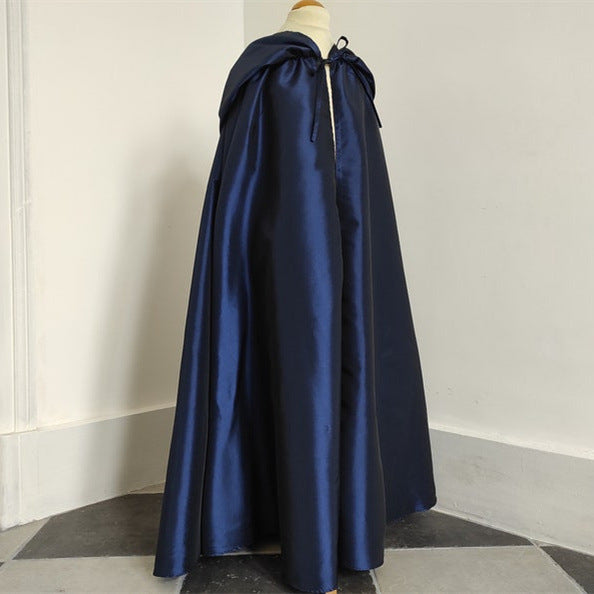 Costume Cloak, Retro Large Loose Cape with Hood, Stage or Evening Wear
Below, we break down how to judge velvet quality, how to style a cloak for daily wear, and which pieces in our collection earn their place in a rotation.
 Woman in a long black velvet hooded cloak standing by a stone wall at dusk with blurred city lights behind her
How to Choose Velvet and Judge Construction Before You Buy
Most buying mistakes happen before checkout, not after. Velvet is a pile fabric, and the pile is where the quality lives. Run your eye across the surface at an angle: good velvet shifts tone as the nap catches light, and cheap velvet looks flat and slightly shiny in a way that reads as plastic.
Check the lining next. A lined cloak drapes better and protects the pile from friction. Look at the seams inside the hem, too. Tight, even stitching holds up; loose or wavy stitching means the garment will pull apart at the shoulders within a season.
Then test the closure. Lace-up fronts and clasp closures distribute weight differently than a single tie, and a cloak that hangs from one narrow point will drag on your neck all evening.
Velvet, Velveteen, and Velour: What the Label Tells You
The label tells you more than the product photo ever will. Velvet is a woven pile fabric, usually with a dense, soft hand. Velveteen has a shorter, tighter pile and a matte finish, which is why our Nerezza coat uses high-grade weft velveteen for its structured, tailored look. Velour is a knit, stretches more, and drapes loosely, so it suits casual pieces rather than dramatic silhouettes. Because pile, stretch, and drape shape a cloak’s silhouette, the same distinctions can help when choosing unique wardrobe pieces for performers.
For gothic velvet cloaks, velveteen often wins on durability because the short pile resists crushing. True velvet gives a richer sheen and a heavier feel. Neither is "better" in the abstract; match the fabric to the silhouette you want. A structured coat with sharp shoulders reads better in velveteen, while a flowing floor-length cloak benefits from the weight and drape of true velvet.
Weight, Drape, and Lining: The Numbers That Matter
Fabric weight is usually given in ounces per square yard (oz/yd²) or grams per square meter (GSM). Ask for the weight if it is not listed, because two cloaks that look identical online can differ by several ounces.
Lining matters as much as the shell. A full lining in polyester satin or taffeta slides over clothing and protects the pile; an unlined velvet cloak will catch on jeans and wear faster at the friction points. Check whether the lining is attached at the hem or free-hanging, free-hanging linings allow more movement but can pull at the shoulders if the attachment is weak.
Seams, Closures, and Hardware: What to Inspect
Look for seams that are finished, not raw. If the cloak has a hood, check that the hood lining is the same fabric as the body lining.
Watch out: a cloak with no closure at the front will slide off one shoulder constantly. If the design is open, plan to pin it or wear it over a structured layer that gives it something to grip.
Black Velvet Cloak Outfit Ideas That Work Off the Costume Rack
A black velvet cloak outfit works off the costume rack when you treat the cloak as outerwear, not a costume piece. Pair it with pieces you already wear and let the cloak carry the drama alone.
-
Everyday dark: a black velvet hooded cloak over a plain black midi dress and ankle boots. One statement layer, everything else quiet.
-
Punk styling: a short lace or mesh cape over a graphic tee, ripped jeans, and heavy boots. The contrast between delicate lace and distressed denim does the work.
-
Movie date: a full-length black shawl over a slip dress and a thin knit. Velvet reads romantic in low light, which is exactly the point.
-
Office-adjacent goth: a mid-length velvet coat over tailored trousers and a turtleneck. It looks like a coat, not a cloak, and that's the trick.
The rule that ties these together: keep the rest of the outfit matte. Velvet already reflects light, so glossy leather or satin underneath competes with it.
The Gothic Hooded Cloak: Fit, Length, and Mobility
Fit decides whether a gothic hooded cloak gets worn or hangs in the closet. The hood should sit up without pulling the shoulders forward, and the front opening should let your arms move freely. If you can't reach forward to hug someone without the whole cloak shifting, it's cut too narrow.
Length matters just as much. A cloak that ends at mid-calf keeps you mobile on stairs and sidewalks. Our reproduction Assassin's Creed hooded loose gothic cloak is cut loose with batwing sleeves and a long body.
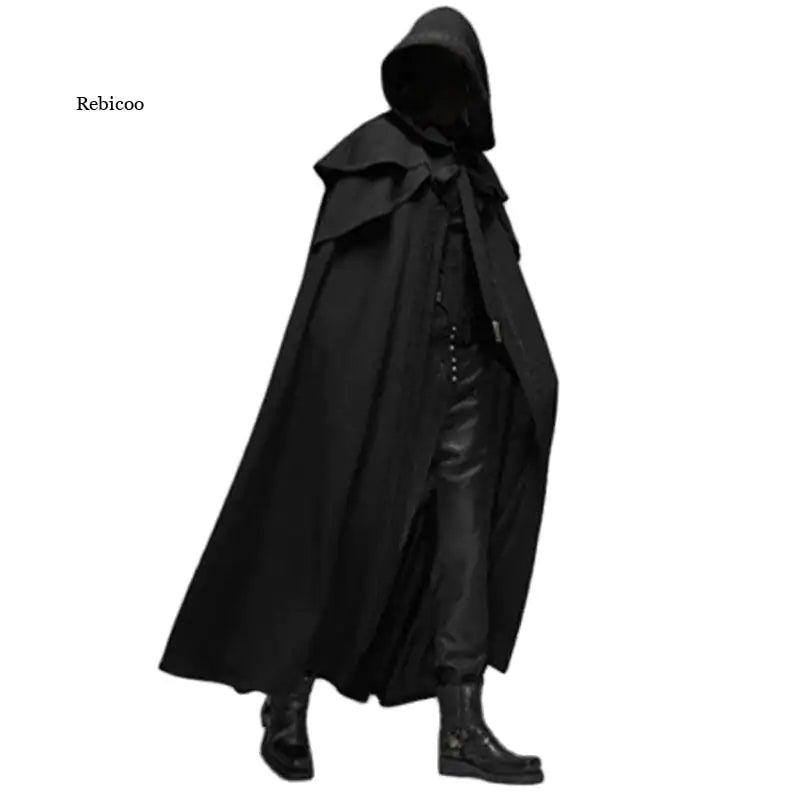 Reproduction Assassin's Creed Hooded Loose Gothic Cloak
Watch out: a cloak with no closure at the front will slide off one shoulder constantly. If the design is open, plan to pin it or wear it over a structured layer that gives it something to grip.
Gothic Cape Styling: Layering, Collars, and Faux Fur
Gothic cape styling lives or dies on what sits underneath and at the neckline. A dramatic collar frames the face and balances a long silhouette, while a plain neckline lets the cloak's texture do all the talking.
Faux fur is the fastest way to add weight and warmth to a cape. Our Punk Rave Morrigan jacquard hooded coat features plush faux fur across the shoulders and cuffs. The Goth Gorgeous Plush Coat takes the same idea further with front faux fur panelling and a corset-lace back for adjustability.
Layering works best in three tiers: a fitted base layer, a textural mid layer like lace or mesh, and the cloak on top. Our Dark In Love lace bell-sleeve cape features sheer nylon lace and trailing bell sleeves. If you want to see how lace reads under a heavier layer, explore the lace mesh hooded cloak and picture it under a velvet coat.
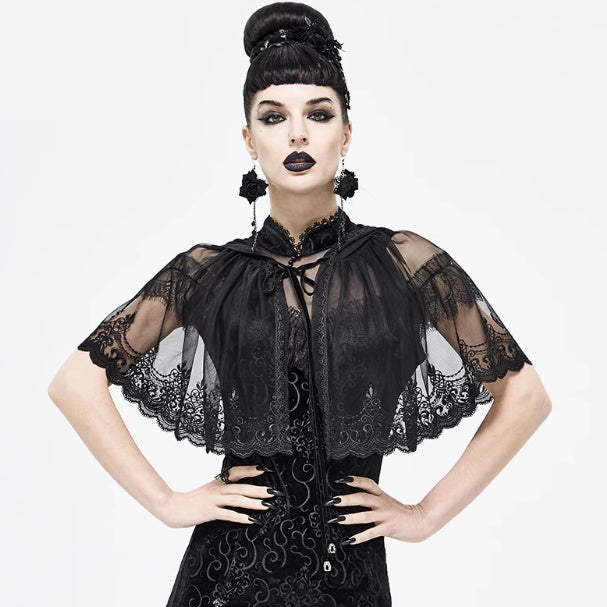 Gothic Fashion Womenswear Dark Lace Mesh Hooded Cloak
Velvet Cloak Costume Ideas for Halloween, Ren Faires, and Cosplay
Velvet cloak costume ideas start with a silhouette, not a character. Pick the shape first, then build the outfit around it. That approach means the cloak keeps working after the event ends.
-
Vampire costume: a full-length black shawl over a high-collar shirt and tailored trousers. Add a jewel-toned accent at the throat.
-
Witch: a hooded velvet cloak over a layered skirt and boots, with a wide-brim hat only if the venue allows it.
-
Renaissance faire: a long cape with a lace-up front over a corset and full skirt. Choose a cloak you can walk in for hours.
-
Cosplay: a loose hooded cloak in a deep color, built to read clearly from a distance and in photos.
For a more theatrical look, a feather cape adds movement that velvet can't. See the feather cape option if you're building a Maleficent-inspired costume or a dramatic Halloween look.
Weather, Warmth, and Care: Keeping Velvet Looking Dark and Rich
Velvet care is mostly about two enemies: heat and pressure. Store cloaks on a wide padded hanger rather than folded, because creases in the pile are slow to recover. Steam gently to lift flattened nap, and keep the iron away from the surface entirely.
For warmth, judge by weight and lining. A thick broadcloth cloak with a full polyester lining holds heat well for winter.
Rain is the enemy of velvet.
Clean sparingly. Spot-clean small marks with a soft cloth and cool water, and take structured velvet coats to a professional cleaner rather than risking the pile at home.
| Fabric |
Warmth |
Best Season |
Care Level |
| Thick velveteen |
High |
Winter |
Professional clean |
| Velvet with lining |
Medium-high |
Fall to spring |
Steam, spot clean |
| Lace or mesh |
Low |
Spring, summer |
Hand wash cool |
| Cotton twill |
Medium |
Spring, summer |
Gentle wash |
Watch out: storing a velvet cloak in a compressed space or on a wire hanger will leave shoulder bumps and creases that may not fully recover.
Customize Your Own Gothic Cloak Design
Custom cloak design is now genuinely accessible, and that changes the buying decision.
Our AI design tools let you describe what you want in plain language to generate design concepts. That matters most for the details that are hard to shop for off the shelf, like a skull motif worked into a collar or an embossed pattern across a back panel.
If you're ready to move from browsing to building, start with the AI design tools and sketch your concept before you commit.
The gap between a cloak you wear once and one you reach for weekly comes down to construction, fit, and honest styling. We built our collection around pieces that cross over: velvet coats that read as outerwear, lace capes that layer into everyday outfits, and hooded cloaks cut for actual movement.
Frequently Asked Questions
What is the difference between a cloak and a cape?
A cloak wraps around the body and usually fastens at the neck or chest, often with a hood and sleeves or arm slits. A cape is shorter and sits on the shoulders, leaving the arms free. In practice, gothic velvet cloaks give more coverage and warmth, while capes work better as a layering piece over corsets, dresses, or bodysuits. If you want drama without bulk, a lace bell-sleeve cape layered over a fitted dress gives you the silhouette without the weight.
Can you wear gothic velvet cloaks outside of Halloween?
Yes, and that is where they earn their price. A mid-length velvet coat over jeans and boots reads as alternative outerwear, not costume. Save the floor-length hooded styles for events, Ren faires, and photoshoots, and use shorter velvet coats for dinners, concerts, and nights out. The trick is pairing one dramatic piece with everyday basics so the cloak is the statement, not the whole outfit.
How do you choose the right length for a gothic hooded cloak?
Start with where you will wear it. Mid-length cuts that hit around the knee or calf are easiest to walk, sit, and drive in. Floor-length styles look dramatic but catch on stairs and pick up street grit. If you are between sizes, check the body size guide rather than guessing, and look for adjustable details like back lacing or drawstrings, which let you cinch the waist and change how the cloak drapes.
What should you wear under a gothic velvet cloak?
Keep the base layer fitted so the cloak does the volume work. A corset, bodysuit, or slim dress in black or deep burgundy keeps the line clean. For colder weather, add a thermal layer underneath rather than a bulky sweater. Finish with boots and one metal accent, such as a cross pendant or buckled belt, so the velvet texture stays the focus instead of competing with too many details.