

Table of Contents
- How Long Do Personalized Canvas Prints Last? The Short Answer
- What Determines the Lifespan of a Canvas Print
- Archival Quality Canvas Prints vs. Standard Prints: What's the Difference?
- How to Protect Canvas Prints From Fading: UV Light and Environmental Factors
- Canvas Print Care and Maintenance: Cleaning, Humidity, and Handling
- Canvas vs. Photo Paper Durability: Why Canvas Lasts Longer
- Mounting, Stretcher Bars, and Frame Construction: The Structural Side of Longevity
- When and How Canvas Prints Deteriorate: Fading, Yellowing, and Oxidation
- Frequently Asked Questions
Last Updated: September 14, 2026
How Long Do Personalized Canvas Prints Last? The Short Answer
Personalized canvas prints typically last 50 to 100 years when printed with pigment-based inks on archival canvas and displayed away from direct sunlight (wilhelm-research.com). This guide from Vireous.Shop explains what decides whether your print survives a decade or a century.
What Determines the Lifespan of a Canvas Print
Lifespan comes down to three variables: ink type, canvas material, and display conditions.
A canvas print is an image printed onto woven fabric, usually cotton or a poly-cotton blend, then stretched over a wooden frame. How long it lasts depends on how those materials interact with light, moisture, and air.

Ink Chemistry: Pigment-Based vs. Dye-Based Inks
Pigment-based inks sit on the canvas surface as suspended color particles; dye-based inks soak into the fibers and dissolve. That difference decides most of a print's fade resistance.
Pigment particles resist UV breakdown far better than dye molecules, which is why archival standards favor pigment (pubmed.ncbi.nlm.nih.gov). Dye prints look more vivid at first, then lose that advantage within a few years in a bright room.
Canvas Material and Substrate Quality
The substrate, meaning the canvas fabric itself, matters as much as the ink. Cheap canvas contains lignin and acids that yellow over time; archival canvas is acid-free and stays neutral for decades. Poly-cotton blends offer a middle ground: cotton holds ink well while synthetic fiber resists sagging.
Archival Quality Canvas Prints vs. Standard Prints: What's the Difference?
Archival quality means acid-free materials, pigment-based inks, and resistance to fading for decades under normal display. Standard prints skip one or more of those steps to cut cost.
The trade-off shows up years later. A standard print may look identical on day one and noticeably duller by year five.
What "Archival" Actually Requires
A print earns the archival label only when every layer in the stack is stable:
- Pigment-based inks rather than dye-based inks
- Acid-free canvas with a neutral pH, typically cotton or a cotton-poly blend
- Acid-free backing board instead of cardboard or foam core
- Lignin-free materials throughout, since lignin yellows and embrittles over time
Skip any one and the weakest layer sets the ceiling. A pigment print on acid-free canvas mounted to a cardboard backing will still yellow, because the backing off-gasses acid into the canvas from behind.
The Museum Standard, Translated
Museums use terms like "conservation grade" and "museum grade" for materials tested for pH neutrality, lightfastness, and resistance to off-gassing. You do not need climate-controlled storage to benefit, just a print built from those materials.
The practical test: ask what the canvas is made of, what ink was used, and what the backing board is. If the seller cannot answer all three, the print is not archival regardless of marketing.
Where Standard Prints Cut Corners
Standard prints usually save cost in one of three places:
- Dye-based inks, cheaper to produce, more vivid initially, far more prone to UV fading.
- Wood-pulp canvas, contains lignin and residual acids that yellow the surface from within.
- Cardboard or foam backing, leaches acid into the print and traps moisture against the canvas.
Any one shortens the print's usable life; two or more can push it into the 10-to-20-year range even in a mild room.
When Archival Is Worth the Upgrade
Archival materials cost more upfront. The question is whether the print is decor or an heirloom.
- Short-term decor, a seasonal print, a rental apartment, a piece you plan to swap in a few years. Standard is reasonable.
- Long-term display, a family portrait, a wedding print, a piece you expect to hand down. Archival materials are the only version that survives the decades.
A useful rule: if you would be upset to replace it in ten years, buy archival. If you would shrug, standard is fine.
The Cost-per-Year View
Buyers often compare sticker prices and stop there. A better comparison is cost per year of display: a standard print that fades in eight years costs more per year of enjoyment than an archival print that holds for forty, even if the archival version costs two or three times as much upfront. The math only favors standard when the print is genuinely temporary.
How to Protect Canvas Prints From Fading: UV Light and Environmental Factors
Keep canvas prints out of direct sunlight and away from humidity levels above 60 percent (si.edu). Those two changes alone add years to a print's life.
UV radiation breaks the chemical bonds that hold color together. Humidity swells the canvas, loosens the weave, and encourages mold in the frame.
The Role of UV Protection and Direct Sunlight
A UV protective coating or laminate filters the most damaging wavelengths before they reach the ink. It is not a force field, but it slows fading considerably.
Indirect, diffused light is safe; a south-facing window with no shade is not. If you love a spot with harsh afternoon sun, rotate the piece every few months or add UV-filtering film to the glass.
Canvas Print Care and Maintenance: Cleaning, Humidity, and Handling
Clean canvas prints with a soft, dry microfiber cloth and nothing else. Never spray liquid directly onto the surface.
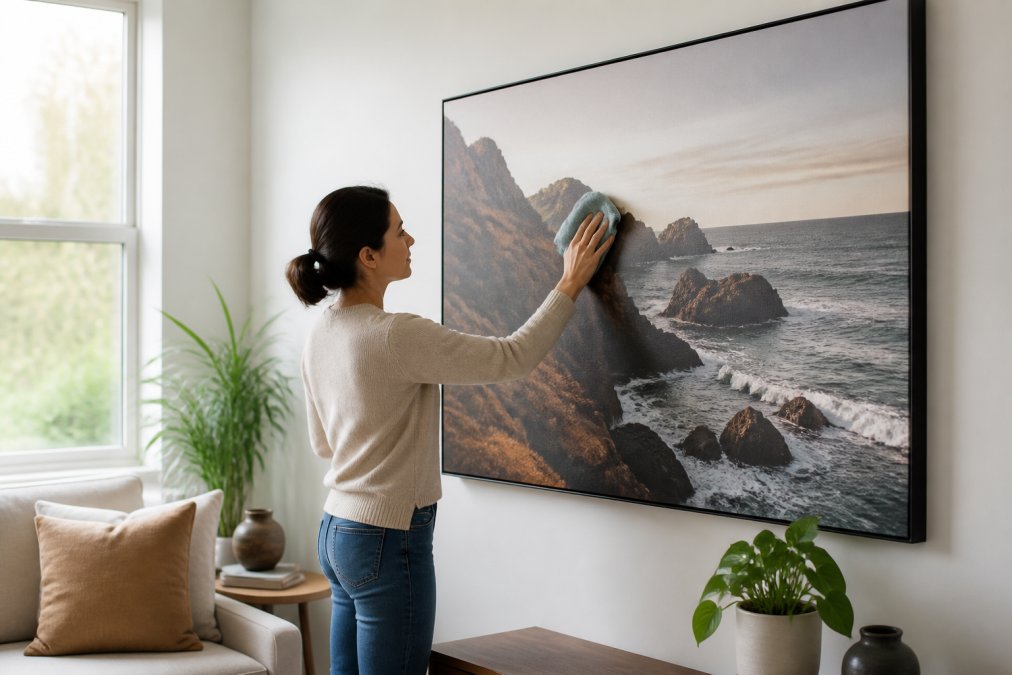
Dust is the enemy you can see; oxidation is the one you cannot. Both are slowed by the same habits: keep the print dry, out of the sun, and handle it by the frame, never the surface.
How to Clean Personalized Canvas Prints Without Damage
Start with the gentlest method and stop as soon as the dust is gone:
- Dust weekly with a dry microfiber cloth, moving in light circles
- For stubborn marks, breathe gently on the spot and wipe immediately
- Never use glass cleaner, alcohol, or abrasive pads on canvas
- Keep the print at least three feet from radiators, vents, and humidifiers
- Check the frame for moisture or warping once a season
Canvas vs. Photo Paper Durability: Why Canvas Lasts Longer
Canvas outlasts photo paper because it holds pigment on a stable, flexible surface instead of a thin, brittle sheet. Photo paper tears, curls, and yellows faster, especially in humid rooms.
| Factor | Canvas Print | Photo Paper |
|---|---|---|
| Typical lifespan | 50-100 years | 10-30 years |
| Fade resistance | High with pigment inks | Moderate |
| Tear resistance | High | Low |
| Humidity tolerance | Moderate to high | Low |
| Frame requirement | Stretcher bars or frame | Frame and glass |
Mounting, Stretcher Bars, and Frame Construction: The Structural Side of Longevity
Stretcher bars and mounting hardware decide whether a print stays flat or sags within a year. A gallery wrap that pulls the image around the frame edge also removes the need for glass, eliminating glare and reflection.

Canvas tension matters more than most buyers realize. A canvas stretched too tight cracks at the corners; one stretched too loose ripples under its own weight. Solid wooden frames hold tension far better than thin composite bars.
The mounting technique matters too: adhesive mounting traps moisture and can bubble over time, while staple-and-fold mounting lets the canvas breathe and stay flat.
When and How Canvas Prints Deteriorate: Fading, Yellowing, and Oxidation
Deterioration follows a predictable order: fading first, yellowing second, structural failure last. Catching it early is the difference between a touch-up and a replacement.
Fading: Why Blues and Reds Go First
Fading is a chemical reaction, not surface wear. UV radiation and visible light break the molecular bonds in the colorants, and shorter-wavelength colors, blues and cyans, tend to be least stable. That is why a sun-faded print often looks warmer and more yellow than the original: the cool tones degraded while the warm tones held on longer.
Pigment-based inks slow this dramatically because the pigment particles are larger and more chemically inert than dye molecules. Dye-based inks fade faster because the dye is dissolved into the coating and more exposed to light and oxygen.
Yellowing: Two Different Causes
Yellowing gets blamed on sunlight, but there are usually two separate mechanisms:
- Internal yellowing, acid and lignin in cheap canvas or backing board break down and discolor the material from within. This is a materials problem and cannot be reversed.
- Surface yellowing, airborne pollutants, cooking grease, tobacco smoke, and dust settle into the weave and oxidize. This is a cleaning problem and is sometimes reversible.
Telling them apart matters: uniform yellowing with an aged-looking canvas is internal; patchy yellowing near a kitchen or window is surface contamination.
Oxidation and the Ink Binder
Oxidation is the slow reaction of oxygen with the ink binder, the polymer that holds pigment particles in place. As the binder degrades, the surface dulls, the print loses contrast, and the ink becomes more vulnerable to abrasion. Heat, humidity, and airborne pollutants accelerate it, which is why a print near a radiator ages faster than one on an interior wall.
Structural Failure: Sagging, Warping, and Corner Cracks
Structural problems come last but are the most visible:
- Sagging canvas, the weave stretches under its own weight, usually from humidity cycling or a frame that cannot hold tension.
- Warped stretcher bars, thin or composite bars bow over time, especially in damp rooms.
- Corner cracks, canvas stretched too tightly cracks at the fold, often within the first year.
- Corner pull-out, staples or tacks loosen and the canvas lifts away from the frame.
These are frame and mounting problems, not ink problems, and can sometimes be fixed by re-stretching the canvas on new bars, far cheaper than reprinting.
What You Can Actually Do About Damage
Once damage appears, the options depend on the type:
- Surface dust and light contamination, dust with a dry microfiber cloth. Do not use liquid.
- Surface yellowing from smoke or grease, consult a conservator. Household cleaning pushes contaminants deeper into the weave.
- Internal yellowing or fading, not reversible. The print can be reprinted from the original file, but the damaged canvas cannot be restored.
- Sagging or loose canvas, a framer can re-stretch the canvas on new stretcher bars, preserving the printed image.
- Corner cracks or tears, a conservator can sometimes patch from behind, but the repair is usually visible up close.
The Lifecycle View: Repair vs. Replace
The decision to repair or replace usually comes down to three questions:
- Is the original digital file still available? If yes, reprinting is often cheaper than restoration.
- Is the damage structural or chemical? Structural damage is more fixable; chemical damage is not.
- Is the print replaceable in sentiment? A family portrait is worth restoring. A mass-produced decor piece usually is not.
Prints showing early surface yellowing can often be saved with professional cleaning, while prints with internal yellowing are effectively at end of life. Knowing which one you have prevents paying for a restoration that cannot succeed.
Frequently Asked Questions
Do canvas prints fade over time?
Yes, canvas prints can fade, but how quickly depends on the inks and materials used. Prints made with pigment-based inks and UV protection resist fading far longer than dye-based alternatives. Direct sunlight, humidity, and airborne pollutants speed up deterioration. A personalized canvas print kept out of direct sun and displayed in a stable indoor environment can hold its color for decades, while a cheap print in a sunny window may show noticeable fading within a year or two.
What is the difference between archival and standard canvas prints?
Archival quality canvas prints use acid-free materials, pigment-based inks, and protective coatings designed to resist fading, yellowing, and oxidation for decades. Standard prints often use dye-based inks and untreated canvas that break down faster when exposed to light and humidity. The gap matters most for personalized gifts or gallery-style wall art you plan to keep long term. Choosing archival materials upfront costs more but avoids replacing a faded print in a few years.
How should I clean my personalized canvas prints?
Dust your canvas print every few weeks with a soft, dry microfiber cloth or a clean feather duster. Avoid glass cleaners, alcohol, and abrasive sponges because they strip protective coatings and dull the print surface. Keep humidity levels between 40 and 60 percent and hang the print away from kitchens, bathrooms, and direct sunlight to extend its life.
How can I protect my canvas prints from sun damage?
Hang canvas prints on walls that receive indirect light rather than direct sunlight. If a sunny spot is unavoidable, use UV-filtering window film or curtains during peak daylight hours. A protective laminate or UV coating applied during printing adds another layer of defense. Rotating prints between rooms every few months also limits cumulative light exposure. These steps slow fading and help your personalized canvas print keep its vibrancy for years longer.
The real challenge with canvas prints is not choosing a design, it is choosing materials that hold up for decades. Vireous.Shop prints on poly-cotton blend canvas with water-based HP Latex inks and UV protection, stretched over solid wooden frames built to keep their tension. Every piece ships from a made-to-order process with same-day or next-day dispatch, so your custom artwork arrives ready to hang. Customize your own canvas print at Vireous.Shop and create wall art built to last.