

Table of Contents
- Why Now Is the Right Time to Monetize AI Art Designs
- Choosing the Right AI Image Generation Tools for Commercial Work
- AI Art Copyright: What Every Creator Must Know in the US
- AI Art Licensing: How to Sell Commercial Rights to Your Designs
- Platforms to Sell AI Art: Print-on-Demand, Digital Downloads, and Beyond
- How to Monetize AI Art Designs Through Passive Income Streams
- Building a Brand Identity That Sells AI Art at Scale
- Common Mistakes That Kill AI Art Revenue (And How to Avoid Them)
Last Updated: August 2, 2026
Generative AI has created one of the most accessible creative economies in history, and understanding how to monetize ai art designs is now a genuine skill set worth developing. This guide from Vireous.Shop breaks down every viable revenue path, from print-on-demand storefronts to licensing commercial rights. The window is wide open right now, but the creators who build durable income treat this like a real business: understanding copyright, preparing files correctly, and building a brand that compounds over time.
File quality, platform compliance, and consistent prompt workflows are what separate hobbyists from creators earning meaningful passive income.
Why Now Is the Right Time to Monetize AI Art Designs
Print-on-demand platforms, stock photography sites, and digital download marketplaces are actively accepting AI-generated creative assets in 2026. Many have updated their terms of service to accommodate AI art explicitly, and consumer appetite for unique, personalized visual content is growing across home decor, apparel, and digital media.
The early-mover advantage in AI art monetization is not about being first to a platform. It is about being first to build a recognizable niche. Creators who pick a specific aesthetic, defined subject matter, or consistent style and produce volume within that niche are the ones building sustainable revenue.
According to the U.S. Copyright Office's 2023 guidance on AI-generated works, works produced entirely by AI without human creative selection and arrangement may not qualify for copyright protection. Human curation, selection, and creative direction are what make your work protectable and commercially viable.
Choosing the Right AI Image Generation Tools for Commercial Work
Tool selection matters less than what you do with the output. The tools that matter for commercial work are the ones that grant you a clear commercial license. DALL-E 3, the technology behind Vireous.Shop's design engine, grants users commercial rights to generated images. Midjourney's paid tiers also permit commercial use. Stable Diffusion, when run locally or through certain API providers, gives you broad rights.
Prompt Engineering for Commercial Consistency
Prompt engineering for commercial consistency is the practice of developing repeatable prompt templates that produce on-brand, commercially usable outputs at scale. Build a prompt library organized by style, subject, and use case rather than writing prompts ad hoc.
Effective commercial prompts typically include:
- Style descriptor: "watercolor illustration," "flat vector graphic," "photorealistic oil painting"
- Subject specifics: precise nouns, colors, and compositional direction
- Negative prompts: explicitly excluding elements that create licensing risk, such as identifiable faces or branded objects
- Output format guidance: "square composition," "transparent background," "high contrast for print"
Negative prompts often matter more than positive ones. Excluding problematic elements upfront saves hours of post-processing.
Technical Post-Processing: Upscaling, DPI, and File Formats
Raw AI output is almost never print-ready. Most AI image generators produce outputs at 72 DPI, which is screen-quality but insufficient for print. Commercial printing requires a minimum of 300 DPI at the intended print size.
Upscaling workflow for print-ready files:
- Generate at the highest native resolution the tool supports
- Run through an AI upscaler such as Topaz Gigapixel or Real-ESRGAN
- Export as a TIFF or high-quality PNG for maximum color fidelity
- Verify DPI metadata is set to 300 before uploading to any print platform
- For vector-adjacent work, trace clean linework in Adobe Illustrator or Inkscape to produce SVG files
PNG is the standard for digital downloads and print-on-demand uploads. SVG is essential for clipart and anything that needs to scale infinitely.
AI Art Copyright: What Every Creator Must Know in the US
The U.S. Copyright Office's position is that purely AI-generated images with no human creative authorship do not qualify for copyright protection. However, images where a human makes meaningful creative selections, including prompt construction, element selection, cropping, color grading, and compositional arrangement, can qualify for protection on those human-authored elements.
Document your creative process. Keep records of your prompts, editing decisions, and post-processing choices. This documentation supports copyright registration claims and demonstrates human authorship.
Some AI models were trained on copyrighted images without explicit licensing, which has led to ongoing litigation. Choosing tools from providers who have taken steps to address training data licensing reduces your exposure. Check the U.S. Copyright Office's AI and copyright resource page for current guidance before filing registrations.
Platform-Specific TOS Analysis: What Each Marketplace Actually Allows
Every platform has its own rules, and "AI art allowed" is not a uniform statement.
| Platform | AI Art Allowed | Disclosure Required | Key Restriction |
|---|---|---|---|
| Etsy | Yes | Recommended | Must be handmade or designed by seller |
| Redbubble | Yes | No explicit requirement | No content violating third-party IP |
| Creative Market | Yes (with review) | Yes | Must disclose AI generation |
| Adobe Stock | Yes | Yes, mandatory | Must tag as AI-generated |
| Shutterstock | Yes | Yes, mandatory | No AI images depicting real people |
| Amazon Merch | Yes | No explicit requirement | Standard content policy applies |
| Society6 | Yes | No explicit requirement | Standard content policy applies |
The disclosure requirement trend is moving toward more transparency. Building disclosure into your upload workflow now protects you from retroactive policy enforcement later.
AI Art Licensing: How to Sell Commercial Rights to Your Designs
AI art licensing is the practice of granting buyers specific rights to use your designs for defined commercial purposes, in exchange for payment. Licensing is where serious revenue lives.
Licensing structures for AI art typically follow the same frameworks as traditional stock photography:
- Royalty-free licensing: Buyer pays once and can use the image within defined parameters indefinitely.
- Rights-managed licensing: Usage is restricted by medium, geography, duration, or exclusivity. Commands higher fees.
- Extended licensing: Covers commercial use beyond personal consumption, such as resale on physical products.
The practical path for most AI art creators starts with royalty-free licensing through established stock platforms, then moves toward direct licensing relationships with brands and agencies as your portfolio builds credibility. Creating design bundles specifically licensed for commercial use and selling them directly through your own digital storefront eliminates platform fees entirely.
Platforms to Sell AI Art: Print-on-Demand, Digital Downloads, and Beyond
The platform you choose determines your margin, your audience, and your operational complexity.
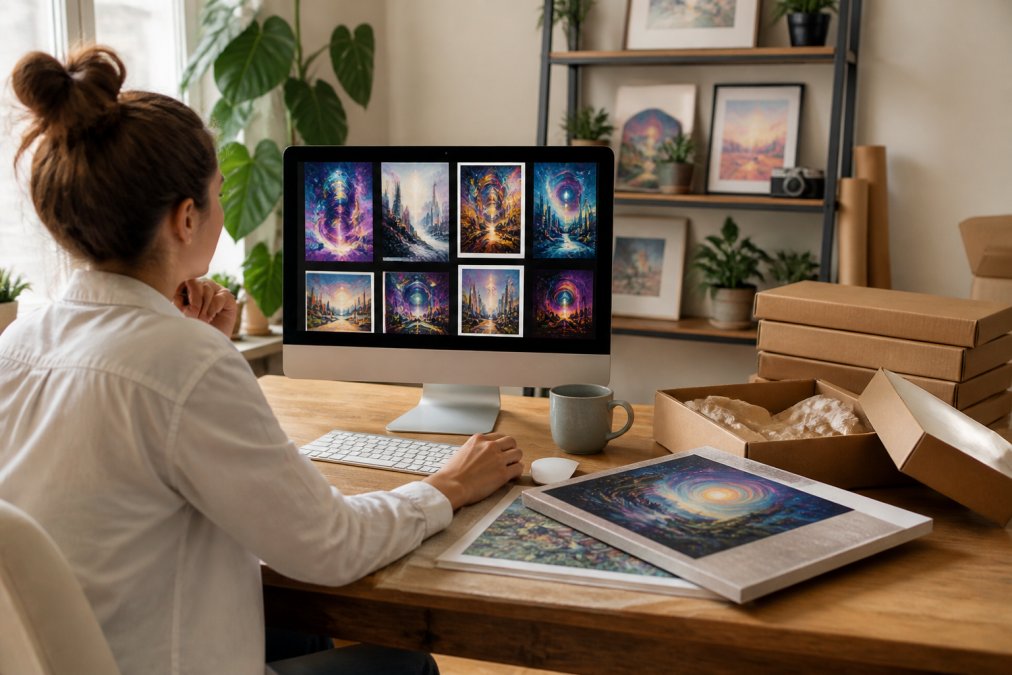
The three primary channels for AI art revenue are print-on-demand, digital downloads, and direct-to-consumer storefronts.
Print-on-Demand Business Models for AI Creators
Print-on-demand is the lowest-friction entry point for monetizing ai art designs. You upload designs, set your markup, and the platform handles production, fulfillment, and customer service. Your margin is the difference between the platform's base price and your retail price.
The business model works best when you treat it as a volume game within a defined niche. A catalog of 50 highly specific designs targeting a passionate audience outperforms 500 generic designs. Buyers searching for "vintage botanical fern art" convert at a much higher rate than those browsing generic abstract prints.
Key print-on-demand considerations for AI creators:
- Verify each platform's AI art policy before uploading
- Test print quality on at least one product before scaling your catalog
- Optimize product listings with keyword-rich titles and descriptions
- Use mockup generators to create professional product photography without inventory
Selling Digital Downloads and Stock Assets
Digital downloads carry the highest margin of any AI art revenue stream because there is no production cost. You create the file once and sell it indefinitely.
The most commercially viable digital download categories for AI art include: clipart bundles, seamless pattern collections, textures and backgrounds, printable wall art, and social media template elements. Platforms like Etsy and Creative Market have established buyer bases actively searching for these assets.
Stock photography platforms represent a parallel channel. Adobe Stock, Shutterstock, and Getty Images' iStock all accept AI-generated content with proper disclosure. According to Adobe's contributor resource center for stock submissions, AI-generated images must be tagged appropriately at upload, and images depicting real or realistic-looking people face additional scrutiny.
How to Monetize AI Art Designs Through Passive Income Streams
Passive income from AI art is real, but it requires upfront work that most tutorials understate. You invest time in creating high-quality, commercially licensed designs, upload them across multiple platforms, optimize listings for search, and then collect royalties and sales as the catalog compounds.
The fastest path to meaningful passive income involves three parallel tracks:
- Stock platform accumulation: Upload consistently to two or three stock platforms. Prioritize quality over quantity, but aim for regular upload cadence.
- Print-on-demand niche dominance: Pick one or two niches and build the most comprehensive catalog available.
- Digital download bundles: Package related designs into bundles priced at a premium. Bundles convert better than individual files.
Tax and Accounting Basics for US Digital Creators
Digital creators selling AI art in the United States are running a business, which means tax obligations apply.
- Self-employment tax: Income from selling digital products and royalties is subject to self-employment tax. Quarterly estimated tax payments are required once your net self-employment income exceeds IRS thresholds.
- Schedule C: Report income and expenses from your AI art business on Schedule C of your federal return. Deductible expenses include AI tool subscriptions, upscaling software, stock platform fees, and home office costs.
- 1099-K reporting: Payment processors and marketplaces are required to issue 1099-K forms when your transactions exceed IRS thresholds.
- State taxes: Many states impose income tax on digital product sales. Some also apply sales tax to digital downloads.
Consulting a CPA familiar with digital creator income is worth the cost. The IRS's guidance on self-employment income is available through the IRS self-employed individuals tax center.
Building a Brand Identity That Sells AI Art at Scale
A brand is what makes a buyer return. The creators building the most durable AI art income are not just uploading designs. They are building recognizable aesthetic identities that buyers associate with quality and consistency.
Social media is the distribution engine for AI art brand building. Instagram and Pinterest are the highest-converting platforms for visual art discovery. TikTok and YouTube Shorts work well for process content, which builds trust and drives traffic to storefronts.
Practical brand-building steps for AI art creators:
- Define your niche before you build your catalog
- Create a consistent posting schedule on one or two social platforms
- Use your storefront's aesthetic consistently across all touchpoints
- Engage with communities in your niche
Vireous.Shop's integration with DALL-E 3 makes it straightforward for creators to produce consistent, on-brand custom designs from natural language prompts.
Common Mistakes That Kill AI Art Revenue (And How to Avoid Them)
Most AI art creators make the same mistakes. Knowing them upfront saves months of wasted effort.
Uploading unoptimized files. Low-resolution images produce blurry prints. Use a consistent post-processing workflow that includes upscaling and DPI verification before every upload.
Ignoring platform TOS. Platforms update their AI content policies regularly. Audit your catalog quarterly.
No niche focus. A catalog of random AI art competes against millions of listings. A focused catalog attracts buyers who know exactly what they want.
Treating all income as profit. Platform fees, AI tool subscriptions, upscaling software, and payment processing costs all reduce your net margin. Track expenses from day one.
Skipping copyright registration. For your highest-value designs, filing for copyright registration with the U.S. Copyright Office creates a legal record of your authorship and enables statutory damages in infringement cases.
The throughline across all of these mistakes is the same: treating AI art monetization as a passive activity rather than a managed business.
Building a profitable AI art business takes more than a good generator and a marketplace account. It requires file preparation discipline, platform compliance, a defined niche, and a consistent brand. Vireous.Shop offers creators a direct path to professional-quality output through its DALL-E 3 integration, with same-day or next-day dispatch on personalized products and a money-back guarantee that removes the risk from your first order. If you are ready to turn your AI art designs into real products and real revenue, customize your first design at Vireous.Shop and see what your imagination produces.
Frequently Asked Questions
Can you actually make money selling AI art designs?
Yes, creators are generating income from AI art through print-on-demand products, digital download marketplaces, stock image platforms, and direct brand licensing deals. The amount you earn depends heavily on your niche selection, the quality of your prompt engineering, how well you prepare files for commercial use, and how consistently you market your digital storefront. Creators who treat it as a structured business rather than a hobby tend to see the most reliable returns.
Is AI art copyrightable in the US?
The US Copyright Office has repeatedly held that purely AI-generated images without meaningful human creative authorship are not eligible for copyright protection. However, if a human creator makes substantial creative choices, such as selecting, arranging, or modifying AI outputs, those elements may qualify for protection. The legal landscape is still evolving, so creators monetizing AI art should stay current with Copyright Office guidance and avoid claiming full copyright over outputs generated entirely by an AI system.
What platforms are best for selling AI art prints in the US?
The right platform depends on your business model. Print-on-demand services handle production and shipping so you focus on design and marketing. Stock image marketplaces accept royalty-free AI art if you disclose its AI origin and meet their resolution and commercial license requirements. Digital download platforms let you sell PNG and SVG files directly to buyers. Each platform has its own terms of service regarding AI-generated content, so review those policies before uploading to avoid account suspension.
How do I license my AI art for commercial use?
AI art licensing involves granting buyers the right to use your designs in specific ways, such as on merchandise, in advertising, or as editorial illustrations. You can offer a standard commercial license, an extended license for mass-produced goods, or an exclusive license for a premium fee. Clearly state what the buyer can and cannot do in a written license agreement. Platforms like Creative Market have built-in license structures you can adapt, or you can draft your own terms for direct sales.
Can AI art generate passive income over time?
AI art passive income is realistic once your catalog is large enough and well-optimized. Uploading designs to print-on-demand and stock platforms creates assets that can sell repeatedly without additional work per sale. The key is building volume across a focused niche, using strong titles and tags for discoverability, and refreshing your catalog regularly. Most creators see passive income grow slowly at first and accelerate after reaching a critical mass of listings, often somewhere above 100 to 200 quality designs.
What file formats and resolution do I need to sell AI art commercially?
For print products, your files generally need to be at least 300 DPI at the final print size. Most AI generators produce images at screen resolution, so upscaling with dedicated tools is a required step before listing. PNG is the standard for digital downloads and print files with transparency. SVG format is preferred for clipart and vector graphics because it scales without quality loss. Stock photography platforms typically specify minimum pixel dimensions in their submission guidelines, so check each platform's requirements individually.
Do I need to disclose that my art was AI-generated when selling it?
Several major stock image platforms, including Adobe Stock and Shutterstock, now require creators to disclose AI-generated content at the time of submission. Failing to disclose can result in removal or account termination. Some print-on-demand marketplaces are also updating their terms of service to require disclosure. Beyond platform rules, transparent disclosure builds trust with buyers, particularly those purchasing commercial licenses who need to understand the intellectual property status of what they are buying.
This article was written using GrandRanker