

Table of Contents
- The Shift From Fast Fashion to AI-Inspired Apparel
- Why AI-Generated Fashion Trends for Creators Are Different
- How AI Changes the Visual Language of Your Videos
- How to Design Merch with AI Tools: A Creator Workflow
- The Authenticity Question: Keeping Your Brand Human
- Why You Should Buy Personalized Apparel with Fast Shipping
- Monetizing AI-Inspired Looks Beyond the Video
- Conclusion: Wear the Feed, Not the Filter
- Frequently Asked Questions
Last Updated: September 9, 2026
The average viewer decides within three seconds whether your thumbnail, outfit, and aesthetic are worth their attention (nielsen.com). For vloggers, the clothes you wear on camera are no longer just fabric; they are visual metadata that tells the algorithm and your audience who you are. This is why AI-inspired apparel is trending for vloggers in 2026: it offers a level of visual uniqueness that mass-market retail simply cannot match. At Vireous.Shop, we have watched creators move from buying the same tees as everyone else to generating designs that exist nowhere else on the internet. Below, we’ll show you exactly how this shift works, how to design your own merch with AI tools, and how to keep your brand feeling human when the visuals are machine-assisted.

The Shift From Fast Fashion to AI-Inspired Apparel
The biggest mistake in creator merch is treating it like a commodity. Fast fashion taught us to chase trends, but those trends are, by definition, saturated by the time you see them on a haul video. AI-inspired apparel flips that model. Instead of asking "What is everyone wearing?" you ask "What does my specific digital identity look like?"
This is a fundamental change in how clothing gets made. Traditional supply chains predict demand months in advance, but AI tools let you design and print on a made-to-order basis. When you build your wardrobe this way, you eliminate the risk of dead stock and create a visual signature that is uniquely yours. The shift is from consumption to creation, and it rewards creators who have a clear point of view.

Why AI-Generated Fashion Trends for Creators Are Different
AI-generated fashion trends for creators differ from traditional trends because they are driven by individual prompts rather than collective taste. A trend in fast fashion is a directive from above; an AI trend is an emergent pattern of individual creators exploring similar aesthetics independently.
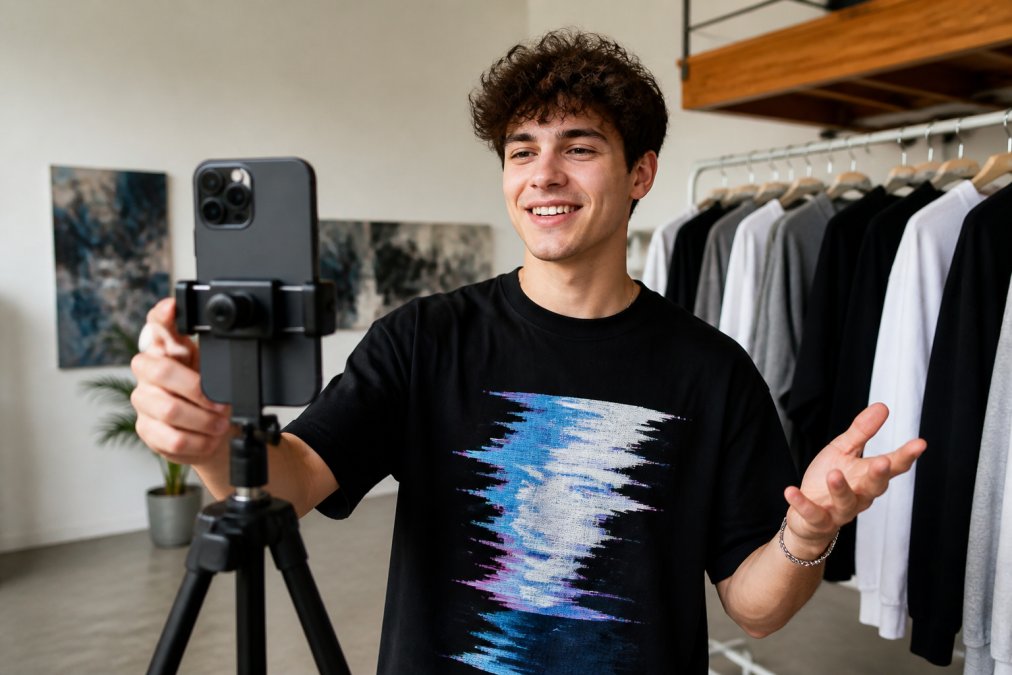
For the vlogger, this means your "trend awareness" matters less than your "prompt fluency." The creators winning right now are not the ones who copy a viral outfit but those who use tools like DALL-E 3 to iterate on a concept until it feels like their own. This is where the concept of pattern generation and algorithmic styling becomes practical. You are not just picking a shirt; you are curating a digital wardrobe that reflects your channel's niche, whether that is cyberpunk, cottagecore, or minimal chaos.
How AI Changes the Visual Language of Your Videos
Your clothing is a graphic element in your frame, and AI changes how that graphic functions. With AI-generated imagery, you can achieve aesthetic consistency across your wardrobe, your thumbnails, and your channel art. This consistency is a signal to the viewer that you are a serious operation, not a hobbyist.
But the real shift is deeper than matching Pantone swatches. AI lets you treat your garment as a dynamic, narrative layer that responds to your content's context. Consider these practical mechanisms that go beyond simple print-on-demand:
Context-Aware Design Iteration Instead of designing one static print, you can generate a design family. For a tech-review channel, you might create a base prompt for a "circuit-board texture" and then iterate variations for different video themes: a warm copper tone for a hardware review, a cool blue for a software tutorial, and a monochrome version for a news update. The visual language of your wardrobe then mirrors the structure of your content calendar, creating a subconscious association for regular viewers.
The 'Second Screen' Effect Viewers often watch on a phone while a laptop is nearby. AI-generated prints with high-frequency details, like glitch art, data streams, or fractal patterns, create a subtle moiré effect on camera that catches the eye even at small sizes. This is a deliberate technique used by motion graphics designers, and it translates directly to apparel. A bold, high-detail print ensures your outfit remains visually interesting even in a small thumbnail or a picture-in-picture window.
Extending the Edit Your editing style is part of your brand. If you use jump cuts, AI-generated prints with sharp geometric shapes complement that frenetic energy. If your videos are long-form and meditative, a print with flowing, organic AI-generated forms will feel more cohesive. The goal is to make your clothing feel like a native part of the video edit, not an external object placed in front of the camera.
The Practical Test: Motion and Compression A common pattern among creators is designing a print that looks stunning in a still render but fails in motion. H.264 and H.265 codecs compress high-detail areas, leading to blocking artifacts around intricate patterns (ieee.org). When you generate a design, you should test it on a moving mockup. Most practitioners find that designs with bold shapes and limited color palettes survive compression better than those with subtle gradients or fine text. This is the difference between designing for a screen and designing for a video feed.
By understanding these mechanisms, you move beyond simply wearing a cool shirt. You are actively engineering a visual component of your video that reinforces your brand's identity with every frame.
How to Design Merch with AI Tools: A Creator Workflow
Designing merch with AI tools is a four-step process that takes most creators from blank canvas to checkout in under an hour. The workflow prioritizes iteration speed so you can test multiple concepts before committing to a print run.
- Define the Prompt: Start with the emotion and niche, not the object. Instead of "cat t-shirt," write "surrealist watercolor of a cat dissolving into binary code, moody lighting, high contrast." Detail is your friend here.
- Generate and Select: Use a tool like DALL-E 3 to generate a batch of variations. Look for designs with strong contrast that will read well on camera and from a distance.
- Refine the Mockup: Place your selected design on a garment mockup. Check how the print sits relative to the collar and how it looks when you are sitting down, which is your primary on-camera posture.
- Print on Demand: Upload the final file to a service like Vireous.Shop that handles printing and shipping, so you never touch inventory.
The Authenticity Question: Keeping Your Brand Human
There is a tension between the efficiency of AI and the trust you have built with your audience. Viewers are savvy about synthetic media, and they will notice if your merch feels hollow. The solution is not to hide the AI but to make your design intent visible. Authenticity in this context means curation.
You are the editor. The AI generates the raw material, but your taste selects the final design. To maintain trust, share your process. Show a screen recording of your prompt iterations or explain why you chose a specific glitch effect over another. This transparency turns the AI from a threat into a collaborator in your creative process. According to Adobe's research on creator authenticity, audiences respond positively when creators are transparent about their production methods, including the use of AI tools.
Why You Should Buy Personalized Apparel with Fast Shipping
Trends move at the speed of the algorithm, and if your merch takes three weeks to arrive, the moment has passed. This is why the ability to buy personalized apparel with fast shipping is not a luxury; it is a strategic necessity for creators who need to capitalize on a viral moment while it is hot.
When you are planning a video around a specific trend or a holiday, a slow supply chain forces you to predict the future. Fast turnaround allows you to react to the present. If a specific meme or sound blows up on Tuesday, you want the t-shirt ready for your Friday upload. Services that offer same-day or next-day dispatch on personalized items let you keep your content calendar agile. This speed, combined with a Money Back Guarantee, reduces the risk of experimenting with bold new designs that might not perform as expected.
Monetizing AI-Inspired Looks Beyond the Video
Your AI-inspired apparel does not have to be a cost center. It can become a revenue stream that extends your brand beyond the video platform. The shift is from wearing the shirt as a prop to selling the shirt as a product.
While the idea of selling merch is not new, AI changes the economics and the creative workflow in ways that favor the independent creator. Here are the specific, practical models that are emerging:
The 'Digital-First' Drop Creators are moving beyond the video by turning their most-liked designs into limited drops for their community. Because the designs are generated digitally, the marginal cost of a new variant is near zero. You can test which designs resonate with your audience and then offer those specific prints for sale. This is where the concept of a digital wardrobe meets commerce: the outfit you wear in a video becomes a tangible product your viewers can buy to feel closer to the community. This creates a direct line from your creative output to your income, turning your visual identity into a marketable asset.
The 'Design-as-Service' Model A more advanced strategy is to offer your AI-design skills to other creators. Many vloggers lack the prompt fluency or the time to generate their own apparel. You can create a service where you design a signature print for another creator's merch line. This is a high-margin, low-overhead business because the primary input is your creative direction and prompt engineering, not physical inventory. You are selling your aesthetic judgment, not just a file.
The 'Community Co-Creation' Play Instead of designing in a vacuum, you can invite your audience into the process. Use a poll on your community tab to let viewers choose between two or three AI-generated design directions. This does two things: it increases engagement on your channel, and it pre-validates demand for the final product. When you launch the drop, you are not hoping for sales; you are fulfilling a request that your most engaged viewers helped shape.
The 'Limited License' Route For creators with a highly distinctive AI-generated aesthetic, there is a path to license your designs to other brands or retailers. While this is less common, a unique pattern or graphic can be licensed for use on a variety of products beyond apparel, such as phone cases or posters. This transforms your creative output from a single product into an intellectual property asset. The key is to document your design process and maintain clear records of your prompts and iterations to establish provenance.
Each of these models leverages the core advantage of AI: speed and iteration. You are no longer betting on a single design months in advance. You are running a series of small, fast experiments that let your audience tell you what they want to buy.
Conclusion: Wear the Feed, Not the Filter
The line between your digital presence and your physical wardrobe is dissolving. AI-inspired apparel is trending for vloggers because it is the only way to keep your physical appearance moving at the same speed as your content. The filter that defines your video aesthetic can now define your clothing, creating a feedback loop that strengthens your brand identity.
The challenge is execution speed and maintaining your authentic voice. You need a partner that understands the creator economy. Vireous.Shop combines OpenAI's DALL-E 3 integration for custom design generation, same-day or next-day dispatch for personalized items, and a user-friendly design tool that lets you go from prompt to purchase in minutes. Whether you are designing a one-off statement piece or a full merch line, the tools are ready. Get started with Vireous.Shop and turn your imagination into a tangible reality.
Frequently Asked Questions
What makes AI-inspired clothing unique for video production?
AI-inspired clothing often features high-contrast patterns, glitch effects, and surreal graphics that read clearly on camera. These designs create visual interest without relying on fast-moving cuts or filters, helping your on-screen presence stay memorable. The unique patterns also reduce the chance of moiré effects common with fine stripes or checks, making them a practical choice for vloggers shooting in 4K.
Can AI help vloggers create custom merchandise faster?
Yes. AI design tools generate multiple pattern and graphic variations from a single text prompt in seconds, compressing the ideation phase from weeks to minutes. This speed lets you test merch concepts with your audience before committing to a production run. When paired with a print partner that offers fast shipping, you can go from idea to unboxing video in under a week.
How do I keep my brand authentic when using AI-generated designs?
Use AI as a starting point, not the final product. Curate the outputs, combine them with your own typography or photography, and refine the prompt until it matches your established visual identity. Share the design process in a short clip; audiences respond well to transparency about how the art was made. This turns the AI tool into a collaborator rather than a replacement for your creative judgment.
Where can I buy personalized apparel with fast shipping for my next video?
Platforms like Vireous.Shop specialize in made-to-order apparel powered by AI design tools. Their integration with OpenAI's DALL-E allows you to generate a design from a natural language prompt, and they dispatch personalized items the same day or the next business day. This speed is critical for vloggers working on tight production schedules or capitalizing on a trending topic.